







How to Calculate the Norm of a Matrix in R (5 Examples) | norm() Function
In this R programming tutorial you’ll learn how to compute the norm of a matrix using the norm() function.
The content of the tutorial looks like this:
Let’s dig in:
Creation of Example Data
We’ll use the following data as basement for this R tutorial:
set.seed(3826733)               # Create example matrix
my_mat <- matrix(sample(1:10, replace = TRUE, 20), ncol = 4)
my_mat                          # Print example matrix
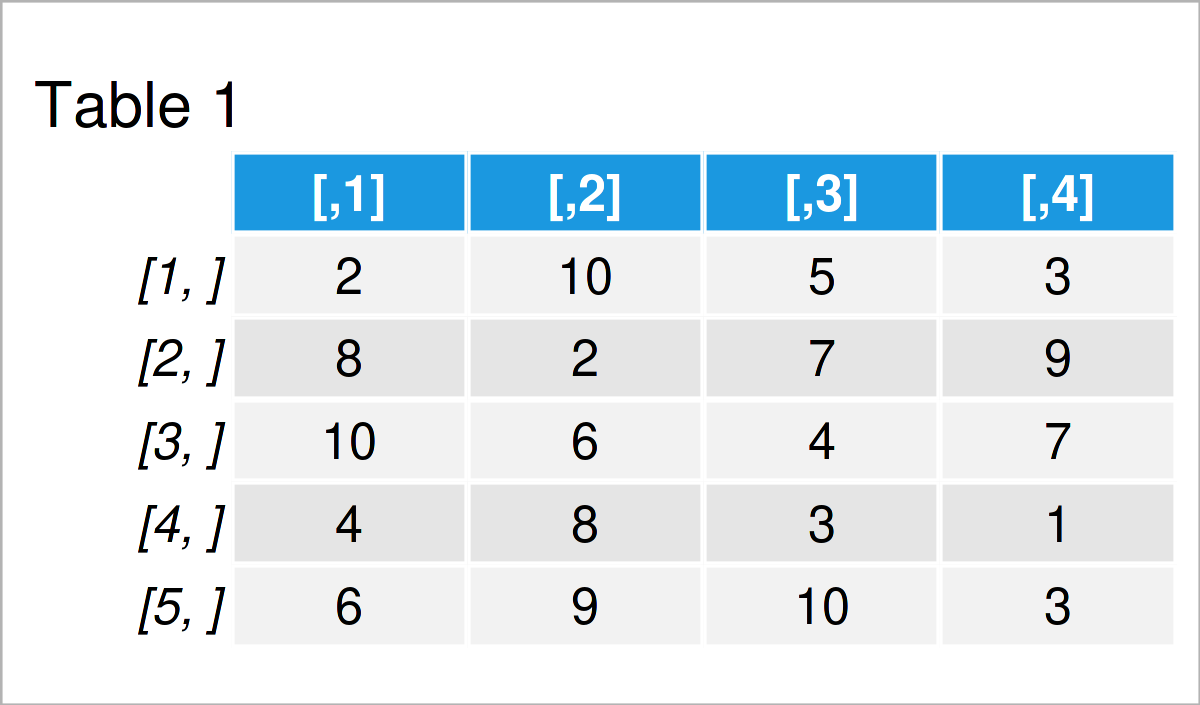
Have a look at the previous table. It shows that our example data contains five rows and four integer columns.
Let’s compute different types of the norm of this matrix.
Example 1: Compute One Norm of Matrix
Example 1 explains how to calculate the one norm of a matrix, i.e. the default specification of the norm function.
Have a look at the following R code:
norm(my_mat)                    # One norm
# [1] 35
The RStudio console has returned the one norm of our example matrix, i.e. 35.
Example 2: Compute Infinity Norm of Matrix
The norm function provides different types of matrix norms.
Example 2 shows how to get the infinity norm of a matrix:
norm(my_mat, type = "I")        # Infinity norm
# [1] 28
Example 3: Compute Forbenius Norm of Matrix
This example illustrates how to return the Forbenius norm of a matrix:
norm(my_mat, type = "F")        # Forbenius norm
# [1] 29.20616
Example 4: Compute Maximum Modulus Norm of Matrix
This example explains how to compute the maximum modulus norm of a matrix:
norm(my_mat, type = "M")        # Maximum modulus
# [1] 10
Example 5: Compute Spectral Norm / 2-Norm of Matrix
This example demonstrates how to calculate the spectral norm (or 2-norm) of a data matrix.
norm(my_mat, type = "2")        # Spectral / 2-norm
# [1] 26.84743
Video & Further Resources
Do you need further information on the R programming codes of this tutorial? Then you may have a look at the following video on my YouTube channel. I’m explaining the content of this tutorial in the video.
The YouTube video will be added soon.
In addition, you may have a look at the other posts on this homepage. I have published several articles already:
- Multiply Rows of Matrix by Vector
- Calculate Determinant of Matrix in R
- Matrix Cross Product in R
- QR Matrix Decomposition in R
- Inverse of Matrix in R
- All R Programming Tutorials
Summary: In this post you have learned how to apply the norm() function in R. Please let me know in the comments section below, if you have any further questions.

I’m Joachim Schork. On this website, I provide statistics tutorials as well as code in Python and R programming.
Statistics Globe Newsletter
Get regular updates on the latest tutorials, offers & news at Statistics Globe. I hate spam & you may opt out anytime: Privacy Policy.