







How to Extract the Intercept from a Linear Regression Model in R (Example)
In this R article you’ll learn how to return the intercept of a linear regression model.
Table of contents:
So without further ado, let’s dive into it.
Creation of Example Data
We use the following data as basement for this R tutorial:
set.seed(894357)                           # Drawing some random data
x1 <- rnorm(200)
x2 <- rnorm(200) - 0.3 * x1
x3 <- rnorm(200) + 0.4 * x1 - 0.2 * x2
x4 <- rnorm(200) + 0.3 * x1 - 0.2 * x3
x5 <- rnorm(200) - 0.03 * x2 + 0.4 * x3
y <- rnorm(200) + 0.1 * x1 - 0.25 * x2 + 0.15 * x3 - 0.4 * x4 - 0.25 * x5
data <- data.frame(y, x1, x2, x3, x4, x5)
head(data)                                 # Returning first lines of data
#            y          x1         x2         x3         x4          x5
# 1  1.1684410 -1.58353017 -1.2234898 -0.3166072  1.5705093 -0.84385144
# 2 -0.1800286  0.09742054  0.7965851  1.5848084  0.2988516  1.89817234
# 3  1.8233851  1.27806258  0.5094414  1.6230221 -0.4993945 -1.75827901
# 4  0.8660731 -0.79919138  0.3025732 -0.4434784 -0.9492395  0.01970439
# 5  3.6639976 -0.77383199 -1.1410142  0.1921179 -1.4590195 -1.64504845
# 6 -0.8836137  0.48293479  0.2443208  1.5685126 -0.2437507 -0.43371700
As you can see based on the previous output of the RStudio console, our example data contains six columns, whereby the variable y is the target variable and the remaining variables are the predictor variables.
Let’s estimate our regression model using the lm and summary functions in R:
mod_summary <- summary(lm(y ~ ., data))    # Executing linear model
mod_summary                                # Return linear regression summary
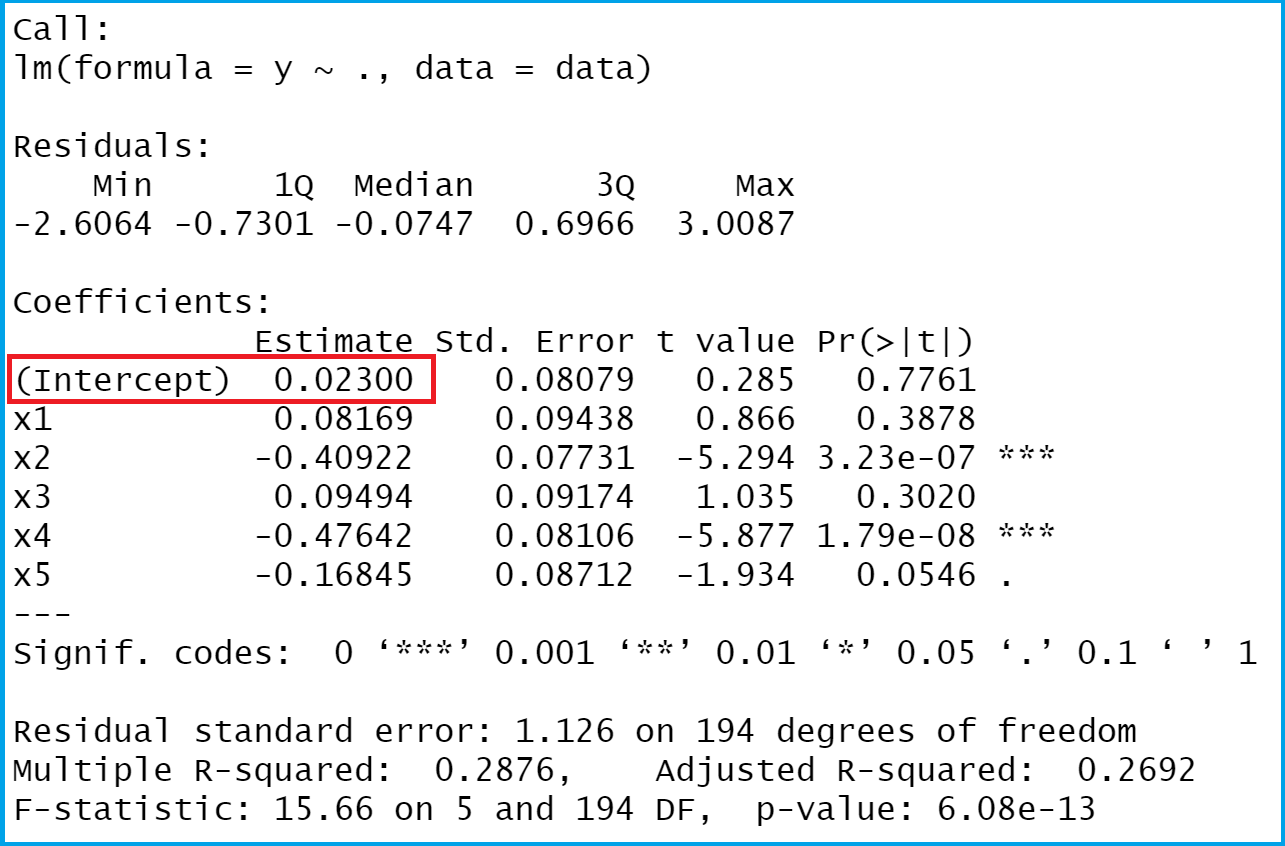
Figure 1 shows the value we want to extract from our linear regression model: The intercept.
Example: Extracting Intercept from Linear Regression Model
The following R programming syntax shows how to identify the intercept of a linear regression analysis:
mod_summary$coefficients[1, 1]             # Pull out intercept
# 0.0230042
Our intercept is 0.0230042.
Video, Further Resources & Summary
I have recently released a video on my YouTube channel, which illustrates the R code of this article. You can find the video below:
The YouTube video will be added soon.
In addition to the video, you might want to read the other articles of this website. I have released numerous posts about regression models already.
- Specify Reference Factor Level in Linear Regression
- Add Regression Line to ggplot2 Plot in R
- Extract Regression Coefficients of Linear Model
- R Programming Examples
Summary: This post showed how to extract the intercept of a regression model in the R programming language. In case you have any further questions, don’t hesitate to let me know in the comments.

I’m Joachim Schork. On this website, I provide statistics tutorials as well as code in Python and R programming.
Statistics Globe Newsletter
Get regular updates on the latest tutorials, offers & news at Statistics Globe. I hate spam & you may opt out anytime: Privacy Policy.